
30 September 2026
Resin Driveways In Marlborough: Why The High Street Splits The Town In Two
Stand at the Town Hall end of Marlborough High Street and you’re standing on a boundary most people never notice. Houses to the north sit on one kind of ground, houses to the south on another, and the difference turns up the moment a digger breaks the old driveway. We cover Marlborough regularly from our base in Swindon, a dozen miles up the A346, and the first thing we ask anyone planning a resin driveway in Marlborough is which side of the High Street they’re on. After that come the conservation area, the classified roads, Wiltshire Council’s kerb licence and, eventually, the price.
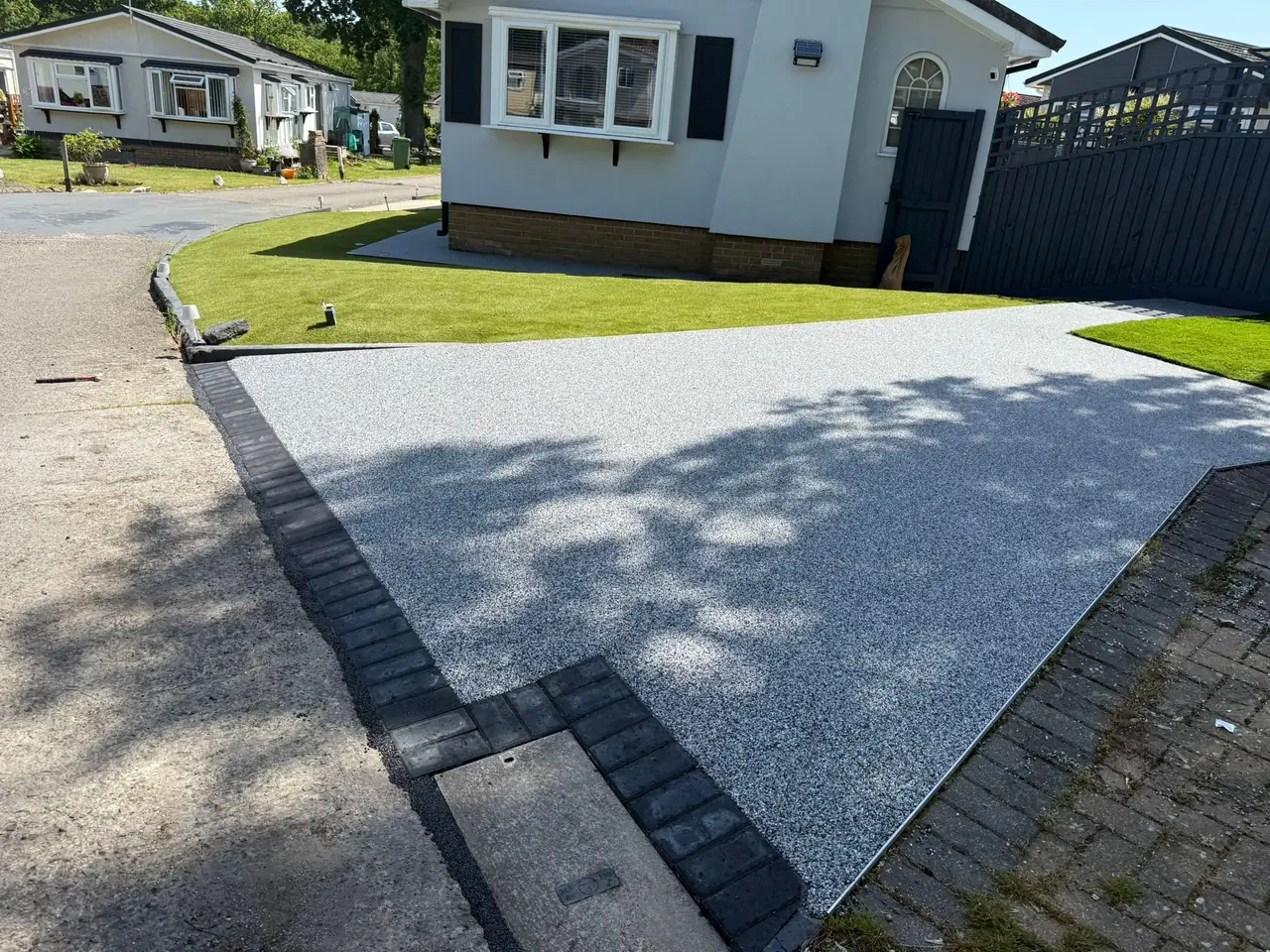
Resin Driveways In Marlborough Start With The Map
The Victoria County History of Wiltshire puts it neatly: the town grew on clay-with-flints north of the High Street and St Martin’s, at about 150 metres, and on the gravel and alluvium of the Kennet and the Og to the south, at around 137 metres. Chalk underlies the lot. It’s the same chalk that forms the Marlborough Downs rising behind the town, and the reason the Kennet runs clear.
You can check your own plot on the British Geological Survey’s Geology Viewer, which maps the bedrock and the surface deposits separately. It’s worth ten minutes. A house on Kingsbury Street or up towards the Common will show something quite different from one near the river meadows or off the Salisbury Road.
None of this rules resin in or out. A resin bound driveway is a thin, porous wearing course, typically 15 to 18mm thick, and it’s only as good as what’s under it. What changes between the two halves of town is how that base gets built.
Flints On The North Side
Clay-with-flints does what it says. It’s a stiff reddish-brown clay packed with hard, sharp nodules, some the size of a fist, some bigger. Excavators don’t love it. The bucket skates on the flints, the clay sticks to everything, and the spoil bulks up more than you’d expect, so skip and grab-lorry costs climb quicker than on a sandy site.
The clay part holds water for longer than chalk or gravel, so a driveway on this side of town needs to be able to shed rain sideways as well as downwards. On most jobs we dig to around 150mm for a car drive, lay a geotextile membrane over the formation, and build up with clean, open-graded stone that gives the water somewhere to sit while the clay slowly takes it. If the formation is soft in patches, which it often is where old flower beds or a buried soakaway have been, we take those out and replace them before any stone goes down.
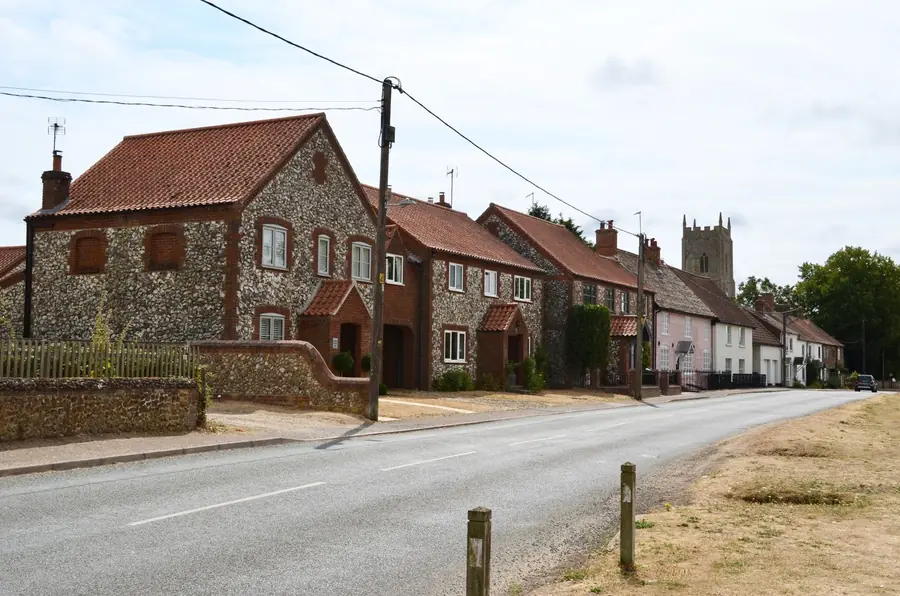
The flints themselves are useful, by the way. They’re what the local builders used for centuries in walls and cottage fronts, and you’ll see brick-and-flint boundaries across the older streets. If one runs along your frontage, it’s often worth keeping and edging the driveway up to it rather than knocking it through for an extra half-metre of width.
Down By The Kennet And The Og
South of the High Street the story flips. Gravel and alluvium drain well in summer, but the water table here is tied to the chalk aquifer and to a river that can rise sharply after a long wet spell. The Kennet is a chalk stream, fed mainly by groundwater, so after a sodden winter the ground can stay saturated for weeks rather than days. The winter of 2013-14 made that painfully clear right along the valley.
For a driveway that matters in two ways. First, a permeable surface is worth more here than almost anywhere in town, because it lets rainfall soak in where it lands instead of running across the pavement into already busy drains. Second, a soakaway has to sit above the winter water level to do anything at all. We’d rather know that before quoting, so we dig a trial hole and look at how wet the ground is at depth, particularly on the lower streets.
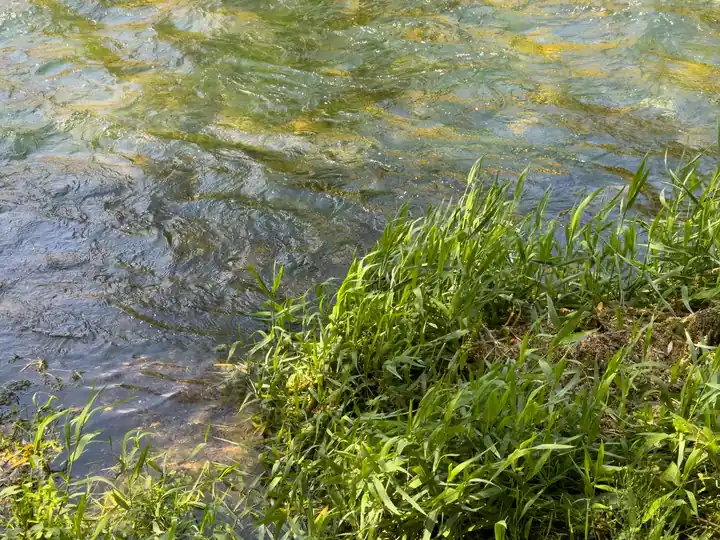
If you want to see how groundwater is behaving near you, the Environment Agency publishes groundwater and river level readings for the Marlborough area. A borehole reading climbing steadily in January is a good hint that your soakaway design needs some care.
The Conservation Area And Listed Frontages
Marlborough’s conservation area was first designated in 1971 and covers the town centre along with a good stretch of the older streets around it. The Town Hall alone is Grade II listed, and it’s in good company. Much of the High Street was rebuilt after the fire of 1653, which started in a tannery at the western end of the south side, so a lot of what you see is late 17th and 18th century work behind later shop fronts.
In practice, very few High Street properties have anywhere at the front to park. Where resin comes up in the town centre it’s usually a rear courtyard, reached through a carriage arch or off one of the lanes behind, or a side yard on a Georgian house on Kingsbury Street or St Martin’s.
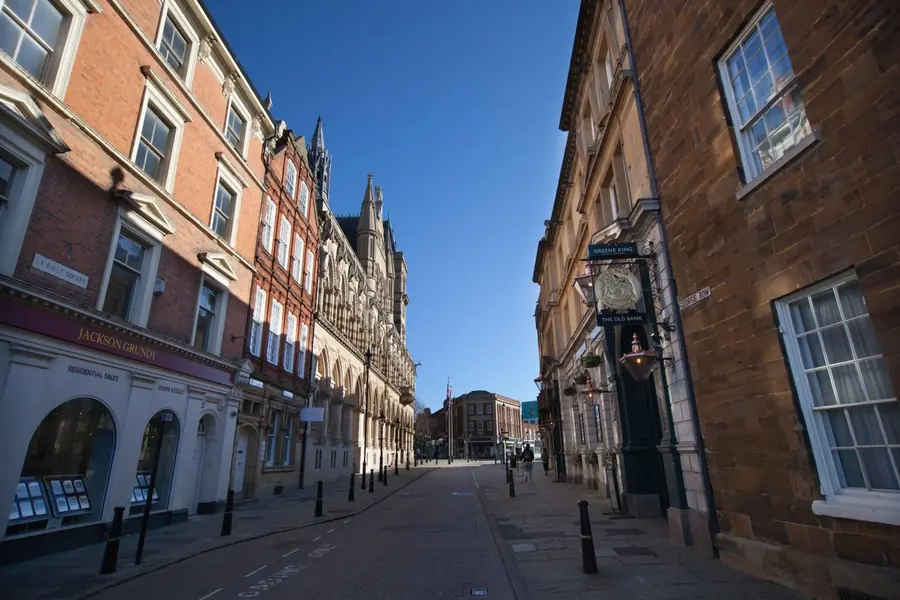
A conservation area doesn’t ban resin. What it does is tighten up a few things around the driveway itself. Knocking down a front wall over a metre high that faces a road counts as demolition and needs planning permission. If the house is listed, changes to walls, railings or other structures within its curtilage may need listed building consent. And a bright, glossy surface in front of a Georgian brick house will look wrong even if nobody stops you laying it. Muted buff and honey aggregates, or a flint-grey blend, tend to sit far more comfortably against the old brick. When Wiltshire Council’s conservation officers commented on the town’s neighbourhood plan, they noted there was no Article 4 direction in Marlborough at that point, but check the council’s current Article 4 map before assuming nothing has changed.
The Front Garden Rule Still Applies
Away from the centre, the question homeowners actually run into is the national one. Since 2008, paving more than five square metres of front garden with a surface that water can’t soak through needs planning permission, unless the rain is directed onto a lawn or border on your own land. The government’s guidance on permeable surfacing of front gardens sets out the options.
Resin bound stone laid over a permeable base passes this test on its own merits, which is one reason we recommend it so often on the valley side of town. The catch is that the base has to be permeable too. Pour resin over an old concrete slab and you’ve got a surface that looks porous but drains nowhere, which puts you back under the planning rule and does nothing for the river.
Marlborough sits inside the North Wessex Downs National Landscape, and people sometimes assume that brings extra driveway restrictions. For a permeable surface on a house, it generally doesn’t. The permeability rule is the same here as in Swindon or Devizes.
Kerbs, The A4 And The A346
If your house has never had a vehicle crossing, you’ll need one before you can legally drive over the footway. Wiltshire Council handles this under Section 184 of the Highways Act 1980. At the time of writing its fee for a standard domestic licence is £295, and it warns that applications can take up to 15 weeks. The licence covers permission only. The construction work is a separate cost, and nothing should be cut until the written approval arrives.
Marlborough has a particular wrinkle here. The A4 runs straight through the High Street, and the A346 heads north towards Swindon and south towards Burbage. Forming a brand-new access onto a classified road isn’t permitted development, so houses fronting those routes need planning permission as well as the kerb licence. Visibility splays, traffic speed and where a car pulls out will all be looked at. On a quiet residential close the process is far simpler, but the licence is still required.
If you’re planning a driveway and the kerb together, apply for the crossing first. A finished resin surface with no legal way onto it is an expensive place to keep the bins.
Matching The Surface To The House
Marlborough’s housing splits roughly into three groups, and each one points to a slightly different driveway.
The late 18th-century red brick houses along St Martin’s, Kingsbury Street and Barn Street usually come with tight plots, old boundary walls and very little room to turn. Small, careful jobs. A resin courtyard or a narrow side drive in a warm buff blend, edged in reclaimed brick, tends to look like it belongs.
Then there’s the early council housing. The town council built houses at Chiminage Close in 1912 and 1923, in Lainey’s Close through the 1920s and in Coldharbour Lane in 1921, with more at St Margaret’s from around 1920 to 1950. Many of these now have front gardens that were grassed for decades and are being converted to parking, which is exactly where the five square metre rule bites.
Finally, the council homes built on Port Field from the 1960s onwards, and the private houses that followed around the edges of town. Wider frontages, often an old concrete drive already in place. These are the most common resin jobs we price here, usually a straight swap: break out the cracked concrete, build a permeable base, and lay a resin bound surface in a mid-grey or natural gravel colour.
What A Resin Driveway In Marlborough Costs
Prices here follow the same logic as anywhere in Wiltshire, with a couple of local twists. The resin itself is fairly steady, somewhere around £100 to £150 per square metre fully laid over a proper base. What moves a Marlborough quote is the dig and the access.
A few rough examples from the sort of jobs we see:
- A two-car frontage on a 1960s or 1970s semi, around 40 square metres, old concrete coming out: roughly £4,000 to £6,500.
- A small rear courtyard behind a town-centre property, 20 to 25 square metres, everything barrowed through an archway: often £3,500 to £5,000, because labour per square metre is higher.
- A larger detached plot on the river side, 60 square metres or more, with a new soakaway sized for the winter water table: £7,500 and up.
Flinty spoil on the north side adds to muck-away costs, and extra drainage adds to jobs near the Kennet. Neither is a reason to avoid resin, but both are reasons to be wary of a price given over the phone. If you’re comparing Marlborough with other Wiltshire towns, our guide to resin driveways in Chippenham covers a very different patch of clay and limestone, and our Marlborough page shows the areas we cover around the town.
Get a free quote for a resin driveway in Marlborough
Frequently Asked Questions
Is Marlborough covered by Swindon Borough Council or Wiltshire Council?
Wiltshire Council. Marlborough used to fall under Kennet District Council, which was abolished in 2009 when the Wiltshire unitary authority took over. So planning questions, vehicle crossing licences and highway matters all go to Wiltshire Council, based at County Hall in Trowbridge. Swindon Borough Council has no involvement, even though the A346 gets you from one town to the other in about twenty minutes.
Do I need permission for a resin driveway on a house in the Marlborough conservation area?
Not automatically. A permeable resin bound surface on a family house is normally permitted development inside a conservation area just as it is outside one. Where you do need something is if the house is listed, if you want to take down a front wall more than a metre high that faces the road, or if you need a new access onto a classified road such as the A4 or A346. Any of those means an application to Wiltshire Council before work starts.
Does the ground in Marlborough cause problems for resin driveways?
It causes different problems depending on where you are. North of the High Street the soil is clay-with-flints, which is heavy and full of hard nodules that slow the dig and fill the skips fast. South of the High Street, towards the Kennet and the Og, it is river gravel and alluvium with groundwater that can rise in a wet winter. Neither stops a resin driveway, but they need different sub-base and drainage decisions.
How much is a resin driveway in Marlborough?
For a typical post-war semi with room for two cars, around 35 to 45 square metres, budget roughly £4,000 to £6,500 including removal of the old surface and a new permeable base. Small courtyard drives behind town-centre properties often cost more per square metre because everything goes in and out by wheelbarrow. A new dropped kerb is on top, with Wiltshire Council's licence fee listed at £295 for a standard domestic application at the time of writing.