
2 October 2026
Resin Driveways In Royal Wootton Bassett: The Old High Street, The New Estates And What Wiltshire Council Expects
Royal Wootton Bassett is a town with two completely different driveway jobs in it. At one end there is a High Street lined with listed buildings and a timber-framed town hall balanced on stone columns, all inside a conservation area. At the other, towards Swindon, there are estates laid out from the 1960s onwards and new-builds still going up on the edges. Both sit on the same lump of Kimmeridge Clay, which is the one thing every job here has in common. The town has grown fast, from just over 11,000 people at the 2001 census to 13,571 in 2021, and most of that growth came with a driveway attached. We’re based six miles east in Swindon, and a resin driveway in Royal Wootton Bassett is one of the more common requests we get from outside the borough. Here is what the job looks like, depending on which end of town you live at.
Resin Driveways In Royal Wootton Bassett: Which End Of Town Are You At?
Start with the thing that confuses more people than anything else. Royal Wootton Bassett has an SN4 Swindon postcode, a Swindon dialling code and Swindon on the road signs, yet the council is Wiltshire. The town was part of North Wiltshire District until 2009, when the districts were scrapped and Wiltshire Council took over as a single unitary authority. Swindon Borough Council stops at the parish boundary. So if you’ve been reading Swindon’s dropped kerb pages or Swindon’s planning guidance, you’ve been reading the wrong council’s rules.
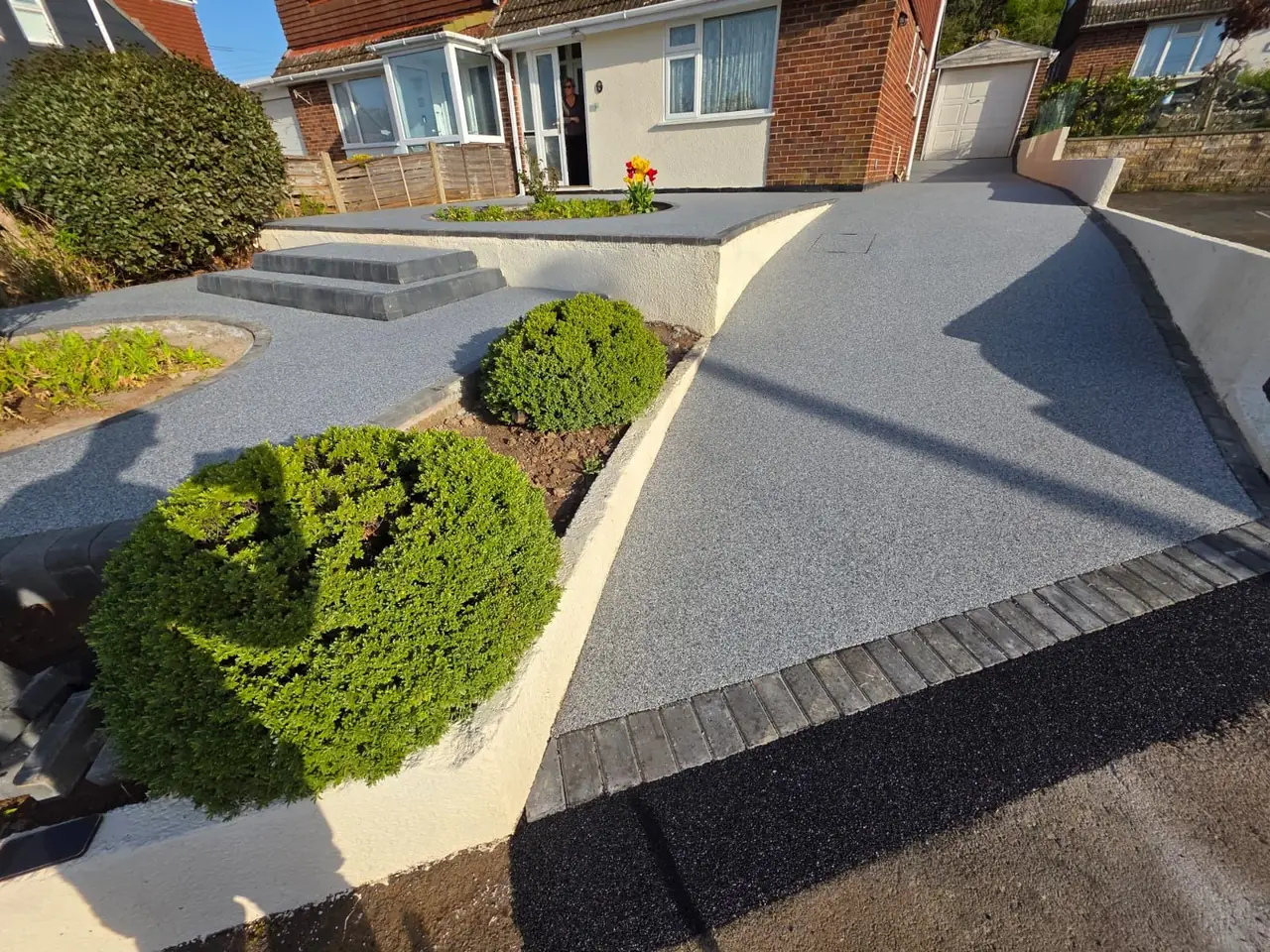
The second thing is the shape of the town itself. It sits on a ridge, with the High Street running along the top and the housing spreading down the slopes on either side. The old core is tight, listed and short of parking. The estates and the newer developments have room to park but were built on ground that was never meant to be dug into lightly. Our Royal Wootton Bassett page covers the areas we work in around the town, but the practical split is simple: old house, small careful job behind or beside the property; estate house, bigger job out front with the ground doing most of the talking.
The “Royal” part, for anyone wondering, dates from 2011. The town was granted the prefix by letters patent in October that year, in recognition of the way residents turned out for the repatriation processions that passed through from RAF Lyneham between 2007 and 2011. It was the first town to be given royal status in over a century, and the war memorial on the High Street is still the focal point for it.
The High Street End: Listed Frontages And A Conservation Area
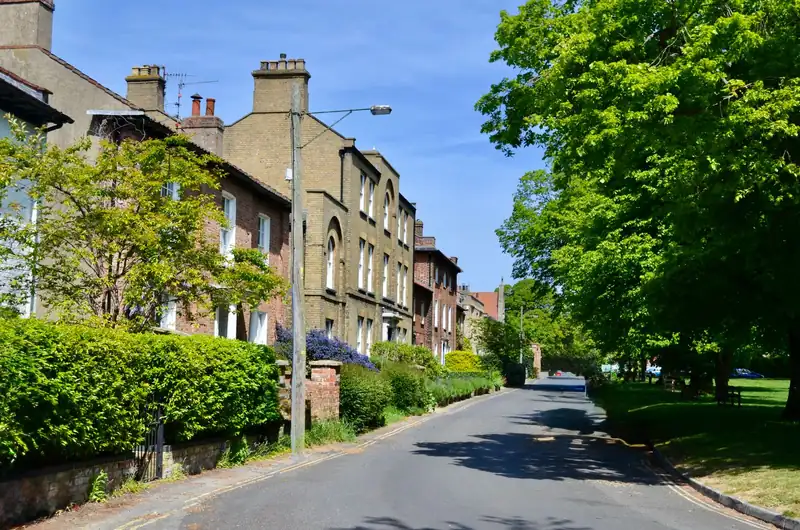
The conservation area takes in the whole town centre along the High Street, running roughly from Lime Kiln Road at the west to Whitehill Lane at the east. The Town Hall in the middle dates from around 1700, was heavily restored in 1889 and stands on fifteen tapered stone columns with an open ground floor beneath. A long run of the two and three storey buildings either side of it are nationally listed, and you can check any address against the register of listed buildings in Royal Wootton Bassett before you plan anything.
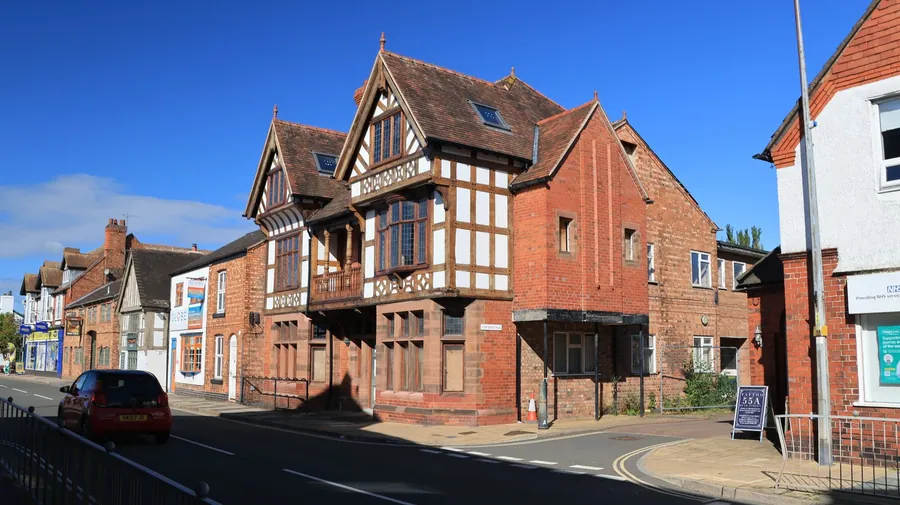
Almost nobody on the High Street itself has a front driveway, and that is the point. Resin work in the old part of town happens round the back: rear yards reached through an arch, side accesses off Station Road or Wood Street, the odd garage court behind a shop. These are small areas, often 15 to 25 square metres, and the labour per square metre is higher because materials come in by barrow rather than by dumper.
Being in a conservation area does not stop you laying a permeable resin surface on a house. What it changes is the list of things around the driveway that need checking. A front boundary wall over a metre high facing the road cannot be demolished without planning permission inside a conservation area. If the building is listed, anything attached to it or within its curtilage, including old walls, railings and gate piers, can need listed building consent. And a bright white or glossy black aggregate will look wrong against 18th-century brick even if no officer ever objects. We tend to steer people here towards a muted buff, a natural stone blend or a soft grey that reads as gravel from the pavement.
Longleaze, Noremarsh And The Estate Years
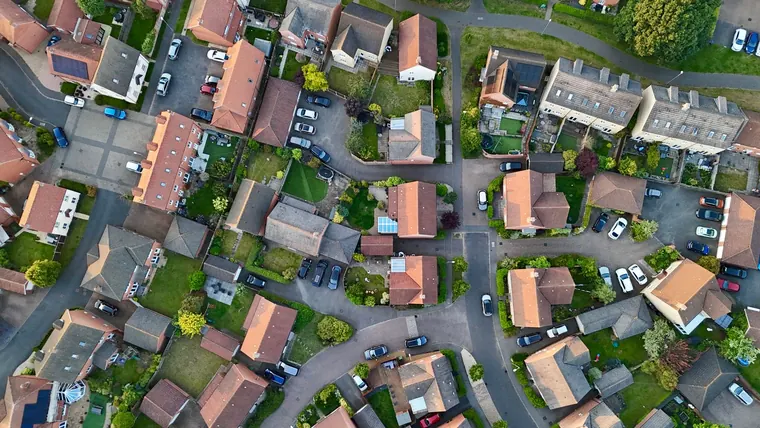
Drop off the ridge and you hit the housing that gave the town most of its current population. The estates around Longleaze and Noremarsh, the roads off Marlborough Road, the closes around Greenway and Hilltop Road: this is 1960s, 70s, 80s and 90s building, mostly semis and detached houses with an integral garage and a frontage wide enough for two cars. These are the plots where the original tarmac or pressed concrete has had forty years of Wiltshire winters and is now cracked, patched, sunken at the garage threshold, or all three.
These are the bread-and-butter jobs for a resin bound driveway installer here, and the jobs follow a pattern. The old surface comes out completely. We do not overlay cracked tarmac on these plots, because whatever cracked it is still underneath. The dig reveals a sub-base that was often thinner than it should have been even when new, sitting straight on clay. We take out the soft material, build a proper permeable base, sort the levels at the garage door so water runs away from the house rather than into it, and lay the resin last.
A lot of these driveways were widened at some point by the owners, usually by laying slabs over the lawn next to the original drive. Those areas are nearly always softer than the original, and they need the full build-up, not a top-up. If you want the whole frontage done in one go and a path round to the back as well, our resin pathways in Royal Wootton Bassett page explains how we tie the two together so there is no step or join where the drive stops and the path begins.
New-Builds On The Swindon Side
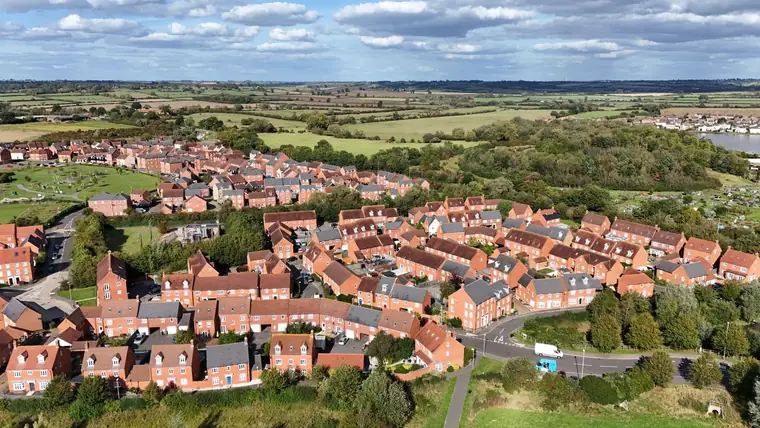
The town’s eastern edge keeps moving towards Swindon. Wiltshire Council has resolved to grant outline permission for up to 95 homes off Marlborough Road, a further scheme of up to 135 homes has been put forward for land north of Swindon Road, and smaller infill developments keep appearing. Houses on the developments finished over the past fifteen years mostly came with block paving laid by the developer, and the question we are asked is whether that can be resurfaced in resin or needs to come up.
It depends on how the blocks have behaved. If they are flat, well-edged and have not sunk at the crossing or the drain gullies, they can sometimes be primed and overlaid, which is cheaper and avoids a skip. If there is any rutting, sunken channels where the wheels sit, or blocks lifting at the edges, the base underneath has failed and resin on top will follow it down. On a new-build that has been standing less than five years we are especially careful, because the ground around the house is usually made-up and still consolidating, and the service trenches for gas, water and fibre run straight under the driveway.
New-build buyers also need to read their deeds. Some developments carry covenants about altering the frontage or the parking area for a set number of years, and the developer’s management company can be fussy about it. Rarely a problem. Still worth a phone call before the quote.
Kimmeridge Clay And A Hill Full Of Mud Springs
Now the ground, because everything above sits on it. Royal Wootton Bassett is built on a ridge of Kimmeridge Clay, with the Corallian limestone, the Coral Rag, underneath it. The clay is somewhere in the region of 10 to 20 metres thick across the town, with older Ampthill Clay beneath that. You can see the bedrock boundaries for your own street on the British Geological Survey’s online Geology Viewer, and it pays to look, because a few streets on the lower slopes come closer to the limestone than others.
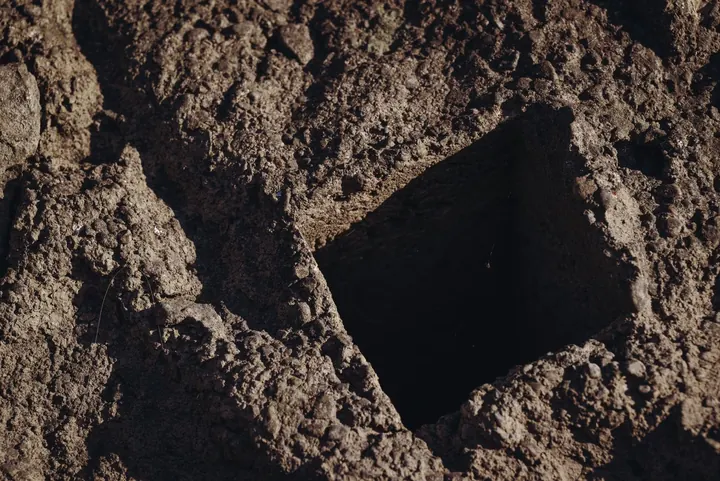
This clay is a proper nuisance for anything laid on it. It swells when wet and shrinks in a dry summer, and it drains very slowly, which is why so many of the older driveways here have moved. The town’s oddest geological feature says it all: the mud springs at Templar’s Firs on the edge of town, a Site of Special Scientific Interest where groundwater pushed up from the Corallian below turns the clay to a slurry that rises to the surface. Nobody is laying a driveway on top of that, but it is a clear illustration of how much water this clay can hold and how little it likes letting it go.
What that means once the digger is in:
- We dig deeper than we would on gravel or chalk, usually to around 200mm for a car drive, and more where the formation is soft.
- A geotextile goes over the clay before any stone, so the sub-base cannot punch down into it.
- The sub-base is clean, angular, open-graded stone, compacted in layers, typically 150mm of it.
- Edge restraints are not optional. On clay the base will creep sideways under load without them.
We covered the same clay problem across the border in our piece on why driveways fail on Swindon’s clay, and the mechanics are identical here. The Oxford Clay that makes Swindon such hard work gives way to Kimmeridge Clay on the Wootton Bassett ridge, and from a driveway’s point of view the difference is academic. You will sometimes see cornbrash limestone mentioned in descriptions of the area, but on the BGS mapping that band sits well to the west around Chippenham and Calne. Under this town, assume clay until a trial hole says otherwise.
Permeable, SuDS And The Five Square Metre Rule
Clay that drains badly makes the choice of surface matter more, not less. Since 2008, paving over more than five square metres of front garden with a surface that does not let water through has needed planning permission anywhere in England, unless the run-off is directed to a lawn or border on your own land. The government’s guidance on permeable surfacing of front gardens explains the rule and the ways to comply with it.

Resin bound stone qualifies, provided the base under it is porous too. That is the catch people miss. Resin laid over an old concrete slab or dense tarmac is porous for about 18mm and then stops, so the rain runs off the edges exactly as it did before. On Kimmeridge Clay the water will not soak away quickly whatever you do, so the open-graded sub-base has a second job: it stores the rain in the voids between the stones and lets the clay take it over hours rather than minutes. On the larger estate frontages we often add a linear drain at the garage threshold too, as belt and braces.
Wiltshire Council is the lead local flood authority for the town, and on new developments it expects drainage to follow sustainable drainage principles. For an individual house replacing its driveway there is no separate SuDS approval to get, but a surface that keeps water on your own plot rather than sending it onto the footway is the standard the council works to, and it is the standard a permeable resin driveway meets on its own.
Dropping A Kerb Through Wiltshire Council, Not Swindon
If the house has never had a vehicle access, or you want to widen one, the kerb outside is Wiltshire Council’s property and you need its permission to alter it. The council runs this as a licence under Section 184 of the Highways Act 1980. In its most recently published fee schedule the standard domestic licence was listed at £310, with the figure due for review from April 2026, so check the current amount before budgeting. The application pack asks for a sketch of the proposed crossing, photographs and details of the driveway surface behind it, and the council’s highways team inspects the site before deciding.
A few things trip people up:
- The licence is permission only. The crossing itself is built separately, by a contractor approved to work on the public highway, and that cost is on top.
- Allow plenty of time. Wiltshire quotes a processing window that can stretch to several months once the inspection and any utility checks are included.
- The driveway behind the crossing has to be long enough to park a car fully off the footway, and the council will look at visibility for anyone pulling out.
- On a classified road, which in this town means the A3102 through the centre and out towards Lyneham, a new access needs planning permission as well as the licence.
The Planning Portal’s page on dropped kerbs sets out the national framework behind all of this, and it is a decent place to start before you ring the council. Our advice is always the same: apply for the crossing before you book the driveway. A beautiful resin surface you cannot legally drive onto is a very expensive patio.
What A Resin Driveway Costs In Royal Wootton Bassett And How We Get There
Prices in the town are driven by three things: the area, the state of the ground, and how easy it is to get a dumper to the plot. The resin bound surface itself, laid over a correctly built base, works out at roughly £100 to £150 per square metre. Whole-job figures from the kinds of work we see most:
- A two-car frontage on a Longleaze or Noremarsh semi, about 40 square metres, old tarmac out and a new permeable base in: £4,500 to £6,500.
- A single-car plot on one of the newer developments, 20 to 30 square metres, developer block paving removed: £3,000 to £4,500.
- A rear courtyard behind a High Street or Wood Street property, 15 to 25 square metres with barrow access only: £3,000 to £4,500, because the labour per metre is high even though the area is small.
- A larger detached plot with a turning area, 60 square metres and up: £7,500 and over.
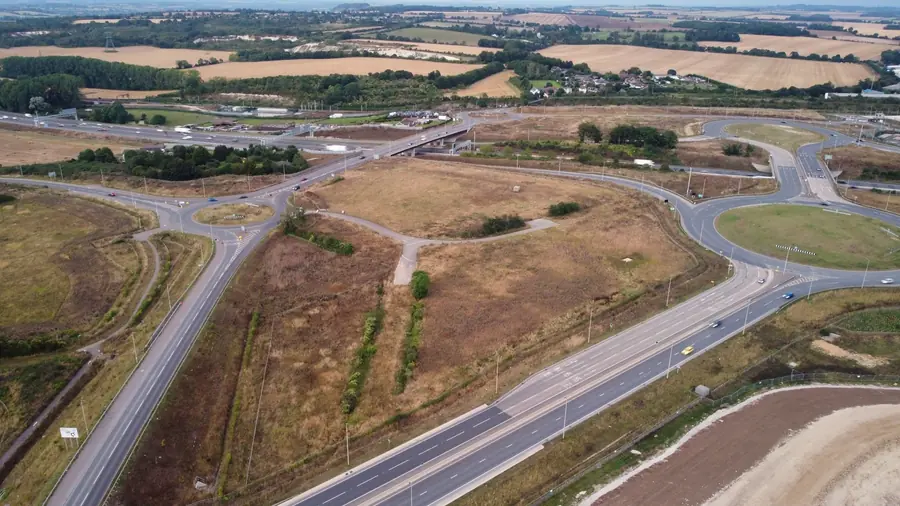
Travel does not feature in any of those numbers. From our base in Swindon it is a straight run west along the A3102 or down the M4 to junction 16 and back up, and the town is close enough that we treat it exactly as we treat Swindon’s own western estates. We also do a fair amount of garden work here alongside driveways, and if you are thinking about the back of the house as well as the front, our resin patios in Royal Wootton Bassett page covers what that involves on the same clay.
One last thing. Because the ground varies from the ridge to the lower streets, and because the older estates hide forty years of previous repairs under the surface, we will not price a Royal Wootton Bassett driveway from a photo. A site visit takes twenty minutes, costs nothing, and is the only way to tell you what is actually under the tarmac before we commit to a figure.
Get a free quote for a resin driveway in Royal Wootton Bassett
Frequently Asked Questions
Which council deals with driveways in Royal Wootton Bassett, Swindon or Wiltshire?
Wiltshire Council, every time. Royal Wootton Bassett has a Swindon postcode and sits a few minutes from the borough boundary, but the town is inside the Wiltshire unitary authority that replaced North Wiltshire District Council in 2009. Planning permission, vehicle crossing licences, protected trees and highway drainage are all Wiltshire matters. Swindon Borough Council's driveway pages do not apply here.
Can I lay a resin driveway on a house in the Royal Wootton Bassett conservation area?
Usually yes, without a planning application, provided the surface is permeable and the house is not listed. The conservation area covers the town centre along the High Street, and it does not remove permitted development rights for a porous driveway on a dwelling. It does bring other things into play: taking down a front wall over a metre high next to the road needs permission, and anything touching a listed building or its curtilage may need listed building consent. If in doubt, ask Wiltshire Council's planning team before booking a contractor.
How deep does a resin driveway sub-base need to be on Royal Wootton Bassett's clay?
More than the bare minimum. On the Kimmeridge Clay under most of the town we would normally dig out to around 200mm for a domestic driveway, lay a geotextile over the formation and build back up with 150mm of compacted open-graded stone before the resin goes on. Soft spots get taken out and replaced rather than bridged. A thinner build will look fine on handover and start settling within two or three winters.
How much does a resin driveway cost in Royal Wootton Bassett?
For a two-car frontage of around 40 square metres on one of the 1970s to 1990s estates, with the old surface removed and a new permeable base, budget roughly £4,500 to £6,500. Smaller single-car plots on the newer developments often come in between £3,000 and £4,500. A new vehicle crossing is extra, with Wiltshire Council's licence fee listed at £310 for a standard domestic application in its most recent published schedule, and the construction work priced separately.