
12 September 2026
How To Read A Resin Driveway Quote In Swindon, Line By Line
Two quotes land for the same Swindon front drive. One is three lines on a phone screenshot and a total. The other runs to two pages and names the stone, the depth, the membrane and the resin system. The second one is £900 dearer, and most people’s instinct is that it is the expensive quote.
It usually is not. It is the one where you can see what you are buying. The cheaper document is not cheaper work, it is undescribed work, and undescribed work is where the difference between a 15 year drive and a five year drive lives. Nobody writes “we will skip the geotextile membrane and lay 80mm of sub-base” on a quote. They just leave the line out.
So this is a read-through of the document itself, top to bottom, in the order the lines normally appear. What each one should say, what the number attached to it should look like, and which absences are the expensive ones.
Start With The Word At The Top Of The Page
Quote and estimate are not interchangeable, and the paperwork trade uses them loosely enough that you have to check. A quote is a fixed offer: accept it and the price is the price. An estimate is a reasoned guess that can move as the job reveals itself. Plenty of firms head a document “estimate” out of habit and then talk about it as though it were fixed, which leaves you with no fixed price at all if things go sideways.
Once you accept a quote you have a contract, and the Consumer Rights Act sits underneath it whether or not it is mentioned. The work has to be carried out with reasonable care and skill and the materials have to be of satisfactory quality, and no clause on the page can sign those away. The government’s summary of your consumer protection rights sets out what you are entitled to. The written document matters because it is the evidence of what was agreed, not because it creates the protection.
Look for the basics while you are up there: a trading name that matches whatever is on the van, a company number if it is a limited company, a real address rather than a mobile number alone, and the date the price expires. A quote with no expiry is a quote nobody expects to be held to. And if you are getting a resin bound driveway priced by three firms, make sure all three are quoting the same square metreage, because a 5m² difference in the measured area explains more price gaps than people realise.
Excavation: The Depth In Millimetres, And Where The Spoil Goes
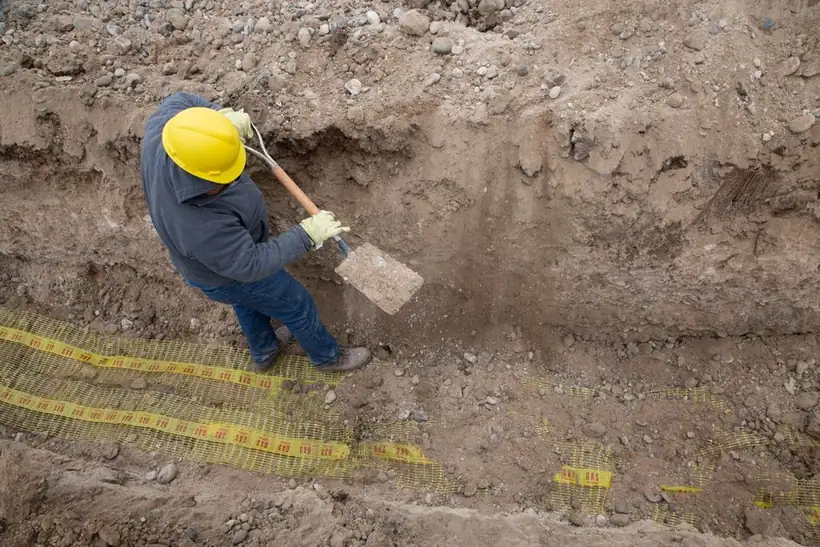
This is the single most common gap. “Excavate existing driveway and remove waste” is a sentence, not a specification. What you want to see is a number: excavate to a formation depth of, say, 250mm below finished level. That number is the whole structure. Everything else stacks on top of it.
Depth is not a fixed national figure, and in Swindon it genuinely varies across town. Up on the Old Town ridge the limestone comes up firm and you can often hit a sound formation quickly. North of the railway, through Abbey Meads, Priory Vale, Taw Hill and Haydon Wick, you are into clay that softens when it is wet and shrinks back in a dry August, and a formation that would be perfectly adequate in Old Town will go soft up there without a deeper stone layer under it. A quote that gives the same depth for every job in the postcode has not been written for your house.
Then look for the disposal line. Spoil is charged by weight, and a 40m² drive dug to 250mm produces around 10 cubic metres, which is somewhere between 15 and 22 tonnes depending on whether it is soil or broken concrete. If that is not separately identified, ask whether it is included, because “removal of waste” attached to no tonnage and no skip count is the line most likely to be revisited. The contractor should also be a registered waste carrier, and you are entitled to the transfer paperwork.
Sub-Base, Membrane, Edges - And The Layer In Between

Four things live in this part of the page. Two of them go missing more often than not, and they are not the two you would guess.
The sub-base line should name a material and a compacted depth. For a permeable resin build that normally means an open-graded clean stone - MOT Type 3, or a 4/20mm clean angular aggregate - laid at 150mm compacted for cars, more where the ground is poor or the drive takes a van. The word to watch for is Type 1. MOT Type 1 is a fine choice under block paving and the wrong choice under a permeable resin surface, because its fines clog and it will not let water through. If the quote says Type 1 under a drive being sold to you as permeable, those two lines contradict each other and one of them is wrong. “Compacted in layers” is worth seeing too, since 150mm dumped in one go and whacked once is not 150mm of compacted stone.
Geotextile membrane is the cheap line with the expensive absence. It is a separation layer between the subgrade and the stone, and on Swindon’s northern clay it is what stops the sub-base slowly pumping itself down into the soft ground over five or six winters. It costs very little to include and cannot be retrofitted. If it is not on the page, it is not in the ground.
Edge restraints should say what and how: aluminium edging pinned and haunched, block paving on a concrete haunch, or an existing kerb being retained. Resin bound has no structural edge of its own. Where it stops without restraint, it crumbles, usually at the pavement end where the wheels turn.
One more line belongs in this part of the document and is missing from a great many quotes: the binder course. Between the sub-base and the resin there should normally be 50 to 65mm of open-graded porous macadam, which gives the resin a stable, closed surface to be trowelled onto. Laid straight onto loose crushed stone instead, the resin has to bridge every void beneath it, the depth goes uneven, and material consumption rises in a way that tempts somebody to spread it thinner. If you cannot find that layer on the page, ask - the answer may be that it is included and not itemised, or that the system is designed for a different base, and both of those are fine to hear. Silence is not.
The Resin Itself: Ratio, Kilos Per Square Metre, And A Named Product

Here is where a good quote stops sounding like a brochure. You want three things: the finished depth, the mix, and a product name.
Finished depth for a driveway should be 18mm using a 6 to 10mm aggregate. Fifteen millimetres is a path depth. Anything advertised as 12mm on a drive is a surface that will not take turning wheels for long. On quantities, a rough sanity check is that 18mm takes somewhere in the region of 27 to 30kg of aggregate per square metre, with resin at around 6 to 7.5 per cent of that weight - so roughly 1.8 to 2.2kg of resin per square metre. If a quote states kilos, you can multiply it out. If it states nothing, you are trusting that nobody stretches the mix on a wet Friday.
The resin type is the line that decides how the drive looks in year eight. UV stable aliphatic resin holds its colour. Aromatic resin is cheaper and ambers - it goes progressively yellow-brown under sunlight, most visibly on pale buff and silver aggregates, which is exactly what most Swindon customers choose. The quote should say aliphatic or UV stable in plain words and should name the system being used, because a named product is a product with a datasheet and a supplier guarantee behind it. “Premium UV resin” names nothing. Ask which brand, and ask whether the supplier guarantee is registered in your name or the contractor’s.
Drainage, Levels And The SuDS Question

Resin bound is permeable, but only as permeable as whatever sits under it. A porous surface over an impermeable base is a bath.
Swindon is a drier town than most of the country, taking roughly 700mm of rain a year against a national average comfortably over a thousand, so the argument for drainage is less about volume and more about where it goes when it does come. The government’s non-statutory technical standards for sustainable drainage systems set the hierarchy: infiltrate on site first, discharge to a watercourse second, and only send it to the sewer as a last resort. Your quote should show which one applies to your drive. On a permeable build over open-graded stone that is usually infiltration, with no further drainage needed. On a clay subgrade with poor percolation it may need a perimeter channel, a soakaway, or a linear drain at the threshold.
Two more things to find on the page. A stated finished level relative to your damp proof course, air bricks and door thresholds, because the new surface has to land low enough not to bridge the DPC. And a fall - a gradient across the surface so water moves rather than sits. If the quote mentions neither, the levels are being worked out on the day, by eye, by whoever turns up. For the full picture of how water behaves under these builds, we went through it in detail in our guide to why groundwork and drainage matter for resin driveways in Swindon.
The Money Lines: VAT, Deposit, And When You Actually Pay

VAT first, because it is a fifth of the bill. A VAT registered firm should show the net figure, the VAT and the gross, and should print its VAT number. You can put that number into HMRC’s check a UK VAT number service and confirm it belongs to the business named on the quote. A firm trading below the registration threshold will have no VAT to show and that is perfectly normal for a small outfit. What you do not want is silence - a total with no indication either way, which is how a £7,000 job becomes £8,400 at the end.
Deposits next. Ten to twenty five per cent is the normal range and it exists because aggregate and resin are ordered in for your specific colour. Half the value before a spade goes in the ground is not a deposit, it is funding. If you signed the paperwork in your own home rather than at the firm’s premises, the Consumer Contracts Regulations give you a 14 day cancellation window, and that right survives unless you have expressly agreed in writing that work can start sooner.
Then the schedule. A sensible one has three or four points tied to progress: deposit on order, a stage payment when the groundwork and base are complete, and the balance on completion after you have walked the drive. Payment tied to dates rather than to finished stages puts the risk entirely on you. Pay the last portion after the handover walk, never before.
Dates, Guarantees, And What “Subject To Ground Conditions” Lets Them Do

Dates should be real. A start date, a working duration, and an acknowledgement that resin cannot be laid onto a wet base or below roughly 5°C. Weather will move a date and everybody understands that, but “we’ll fit you in” is not a date and gives you nothing to hold anyone to.
Guarantees are worth slowing down for. There are two of them and good quotes keep them apart: the workmanship guarantee from the installer, and the product guarantee from the resin supplier. A 10 year workmanship promise from a firm with no trading history behind it is worth what the firm is worth. Ask what the guarantee actually covers - surface failure, delamination, colour change, edge breakdown - and what voids it. We unpacked the fine print in a separate piece on what resin driveway guarantees in Swindon really cover, and the short version is that the exclusions are more informative than the headline number.
Which brings us to the clause that does the most quiet work on the page. “Subject to ground conditions” is not inherently sinister. Nobody can see through soil, and if the digger finds an old coal store footing or a soft spot, someone has to pay for it. The problem is an unbounded version of it, because once the surface is up you have no realistic option to walk away. Bound it instead of deleting it. Ask for the excavation depth the price assumes, a stated rate for anything beyond it - per extra 50mm, or per tonne of additional stone - and a written commitment that you are told and you agree before any extra work is carried out. A contractor who has priced the job properly will not blink at that. One who was relying on the clause will.
The Checklist To Hold Your Quote Against

Print this, sit the quotes side by side, and tick each line off as present or absent. The absences will not be spread evenly.
- Trading name, company number, address, VAT number, and a date the price expires
- Measured area in square metres, so you know all three firms priced the same drive
- Excavation depth in millimetres, and disposal with a tonnage or skip count against it
- Geotextile membrane, named
- Sub-base material and compacted depth, laid in layers
- Binder course, or a straight answer about why there is not one
- Edge restraint type and how it is fixed
- Resin depth of 18mm, aggregate size, aggregate colour by name
- Resin stated as aliphatic or UV stable, with the system named, and kilos per square metre if you can get them
- Drainage approach, and the finished level relative to your damp proof course
- Net, VAT and gross shown separately
- Deposit percentage, and payments tied to finished stages rather than dates
- Start date and working duration
- Workmanship and supplier guarantees in writing, exclusions included
- Any ground conditions clause bounded by a stated rate and your agreement before extra work starts
Three quotes with roughly the same total will separate fast under that list. And the test at the end of it is not who wrote the longest document. It is whether a stranger could build your driveway from the paperwork. If they could not, you do not yet know what you are buying.
Get a free, itemised quote for a resin driveway in Swindon
Frequently Asked Questions
Is a driveway quote legally binding in the UK?
A quote is an offer of a fixed price for defined work. Once you accept it, both sides are bound to it. An estimate is a considered guess and can move. The word printed at the top of the document decides which one you have, so if it says estimate and the contractor is talking about it as a firm price, ask for it to be reissued as a quote. Anything that can change the total after acceptance should be written out as a named condition with a stated rate, not left to be argued about on the day.
What should a resin driveway quote itemise?
As a minimum: excavation depth in millimetres and where the spoil goes, the sub-base material type and its compacted depth, whether a geotextile membrane is included, the type of edge restraint, any binder course under the resin, the finished resin depth, the aggregate and the named resin system, drainage arrangements, VAT position, payment schedule, working dates and the guarantee terms in writing. If any of those are absent, they are not priced, and unpriced work either does not happen or turns into a variation.
Should VAT be shown separately on a Swindon driveway quote?
If the firm is VAT registered, yes, and its VAT number should be printed on the document. You can check that number free on HMRC's online service. If the quote shows no VAT and no VAT number, the firm is telling you it trades below the registration threshold, which is legitimate for a smaller outfit but worth knowing. The problem case is a quote with neither a VAT breakdown nor a statement either way, because the ambiguity is where a twenty per cent argument starts.
How big a deposit is normal for a resin driveway?
Ten to twenty five per cent covers materials ordered in and is reasonable. Half up front on a job that has not been booked into a date is not. Where you signed at your own kitchen table rather than at the firm's premises, the Consumer Contracts Regulations give you fourteen days to cancel, and you keep that right unless you have specifically agreed in writing to work starting inside the period.
What does subject to ground conditions actually mean on a quote?
Used properly it covers the genuinely unknowable: soft spots, an old footing, a buried service that nobody could see from the surface. Used badly it is an open door to repricing the job once the digger has arrived and you have no realistic way of stopping. The fix is not to delete the clause but to bound it. Ask for the depth and sub-base the price assumes, the rate per extra 50mm or per tonne if more is needed, and a line saying you are told and you agree before any extra work starts.